



I recently received a message from a member who teaches Pilates at a studio where different instructors cue different things.
Some teachers teach with an imprinted spine. Others teach neutral spine.
She wanted to know which one was “correct” because she didn’t want to confuse her students.
First of all, this is incredibly common.
Depending on where an instructor trained, who mentored them, and which Pilates lineage they come from, you may hear very different cueing around spinal position. And while some instructors feel strongly one way or the other, my personal take is that there isn’t a universal right or wrong answer.
What Is Neutral Spine?
Neutral spine simply means maintaining the natural curves of the spine.
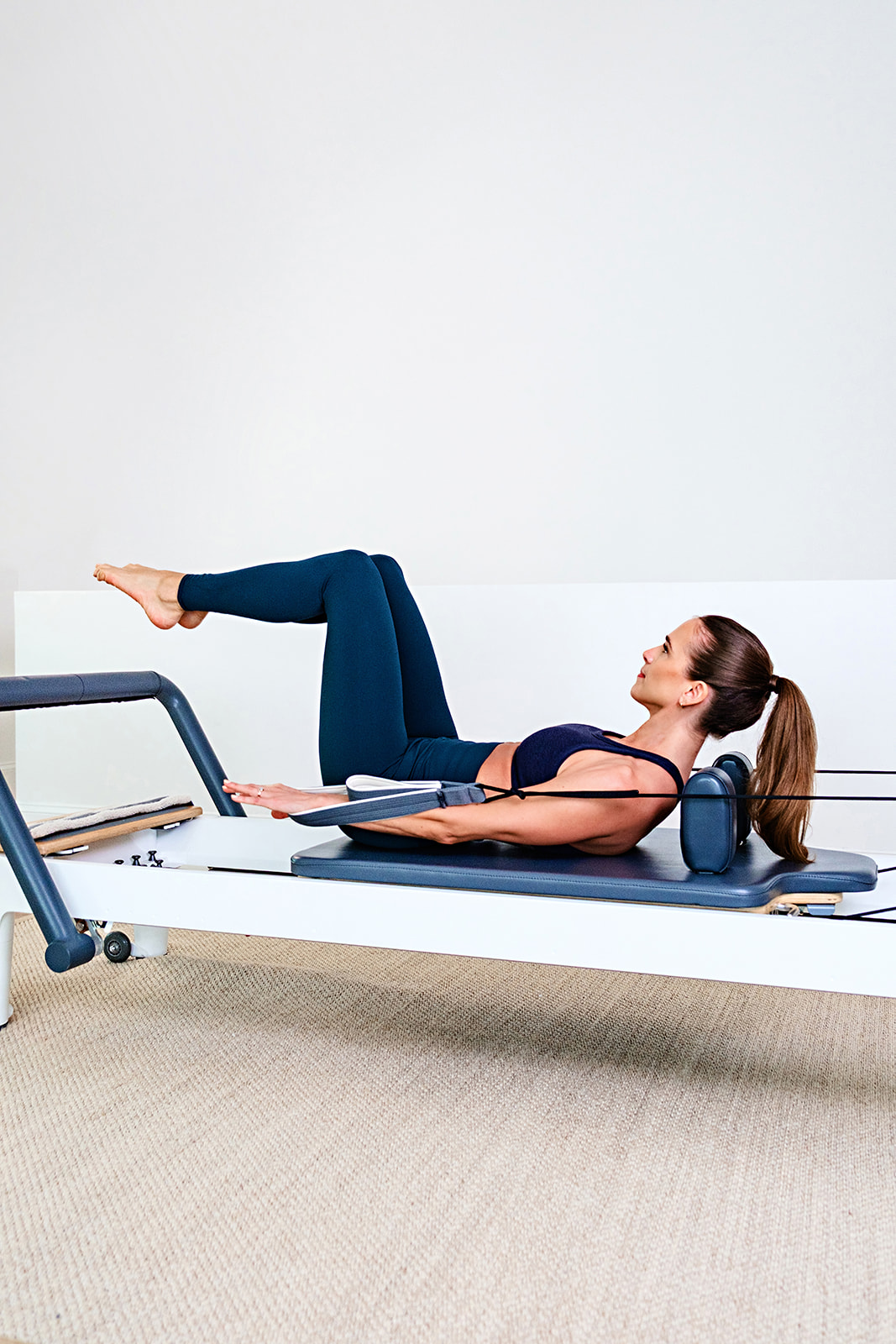
When you’re lying on your back, the top of your pubic bone and two hip bones are on a same plane, parallel to the floor, while the sit bones are pointing straight ahead—not up or down. The back of the ribcage and mid back are connected to the carriage.
There may be some space between your lower back and the carriage, or there may not. (More about that below.)
In my own teaching, I generally encourage a neutral spine during exercises such as feet in straps, supine arm work, and abdominal exercises.
Why?
Because I like teaching people how to stabilize their trunk while maintaining their natural alignment.
What If Neutral Doesn’t Feel Good?
Not everybody can comfortably maintain a neutral spine while doing supine work. It’s actually really, really hard.
And not everybody should.
When we bring the legs into tabletop, some people immediately feel tension in their lower back or struggle to maintain abdominal support.
In those cases, I often encourage students to bring their thighs slightly closer to their chest rather than insisting that the knees remain directly over the hips.
This adjustment can reduce strain and allow the lower back to naturally settle closer to the carriage, flattening out the natural arch of the lumbar spine. This is called imprinting the spine. It’s essentially causing your pelvis to tuck, meaning your pubic bone is now a little higher than your hip bones, and your sit bones are slightly pointing up.
For many people, it feels much better, and they’re able to connect more to their core this way.
What If I’m in Neutral and My Lower Back Is Touching?
This is where I think a lot of confusion comes from.
Many people assume that if the lower back area touches the carriage, the pelvis must be tucked.
Not necessarily.
Some people naturally have a smaller curve in their lower back than others. And for some people, soft tissue may make contact with the carriage even though the lumbar spine is still maintaining its natural curve.
A lower back touching the carriage does not automatically mean someone is in a posterior pelvic tilt.
Rather than focusing on whether there’s a tiny gap under the low back, I pay more attention to whether the ribs are connected, the pelvis feels stable, and the person can breathe comfortably.
My ideal setup during supine abdominal work is usually:
- Knees over hips (or close to it)
- Back ribs resting down
- Especially those lower ribs that often want to pop upward
- Pubic bone and hip bones on one same plane, parallel to the floor
- Sit bones pointing straight ahead, not up
- Back of the shoulders wide and melting down
- Back of the head heavy
What About Intentionally Tucking the Pelvis?
Sometimes I absolutely cue a posterior pelvic tilt.
If someone is struggling to connect to their abdominal wall, arching excessively, or simply can’t find their core connection, intentionally tucking the pelvis can be a useful tool.
It can help them understand where the work should be coming from.
The key is understanding that it’s a strategy, not a rule.
And sometimes I cue a tucked pelvis simply because I feel like changing things up. Different positions create different sensations, and exploring those sensations is part of the fun of Pilates.
My Bottom Line
Ask yourself:
What position allows me to move well, breathe well, feel supported, and still feel challenged?
For some people, that’s a clear neutral spine.
For others, that’s allowing a gentle imprint.
Pilates isn’t about forcing every body into the exact same shape.
It’s about understanding the goal of the exercise and choosing the strategy that helps you achieve it.
One of the things I love most about teaching Pilates is exploring the “it depends” moments. If that approach resonates with you, you’ll feel right at home inside Saran Pilates, where every workout is built around thoughtful movement rather than rigid rules.
I’d love to practice with you. Browse the platform and start your free trial here.
Gabrielle Saran


