

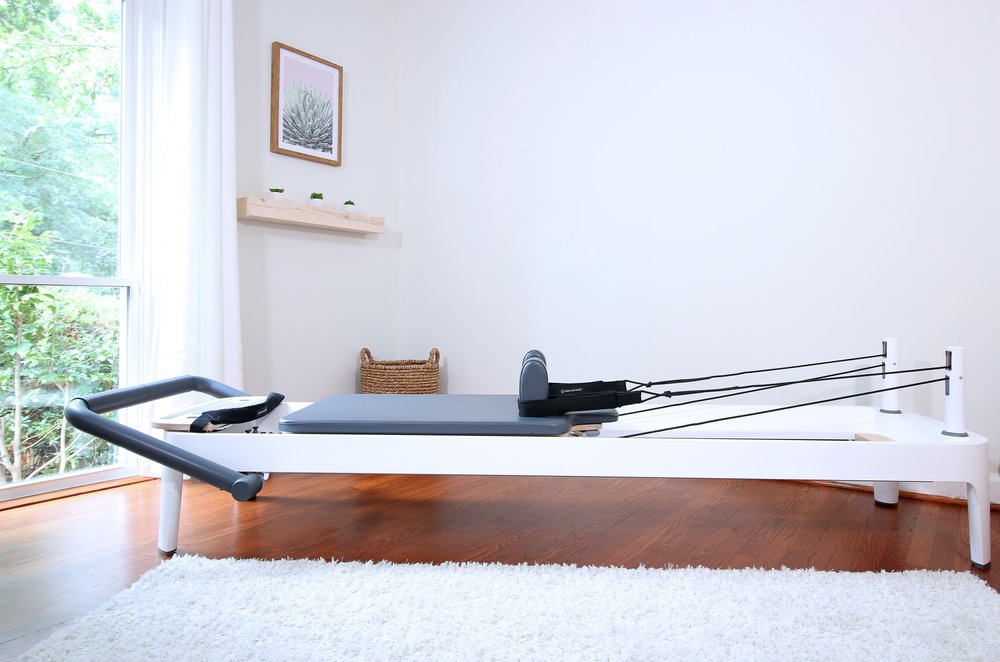


A Pilates Reformer is a piece of exercise equipment designed for low-impact strength training, mobility, balance, and active stretching. It may look complicated at first, but once you understand its basic parts, it becomes surprisingly intuitive.
The Reformer was invented by Joseph Pilates in the early 1900s, and many different versions have been developed since. I teach on the Allegro 2 Reformer by Balanced Body, a model introduced in 2011, but most Reformers operate in a similar way.
How Does a Pilates Reformer Work?
The Reformer uses a moving platform, springs, straps, and a footbar to create resistance and support.
Unlike a traditional weight machine, the Reformer doesn’t lock you into one movement. You control the moving carriage in both directions. Your muscles work as you press away and continue working as you slowly return to the starting position.
The springs can be adjusted to provide more or less support and resistance. However, more springs do not always mean a more difficult exercise. In some movements, lighter springs require more balance and control. Your instructor will tell you which spring setting to use.
A Beginner’s Guide to the Parts of a Reformer
If you have never touched a Reformer, here is what you’ll see and what each part does.
The Carriage
The carriage is the large, padded platform in the center of the machine. It slides forward and backward along the frame.
You may lie, sit, kneel, or stand on it depending on the exercise. When you first use the Reformer, the moving carriage may feel unfamiliar or slightly unsteady. That movement is intentional: controlling the carriage is part of the workout.
You are never trying to make it move as quickly as possible. The goal is usually to move it smoothly and return it with control.
The Springs
The springs connect the carriage to the frame and create resistance. Different spring combinations make the carriage feel heavier, lighter, more supportive, or more challenging to control.
With heavier springs, you may feel more resistance as you press the carriage away. With lighter springs, the carriage may move more easily—but your body may need to work harder to stabilize it.
Your instructor will guide you through every spring change, so you don’t need to memorize the settings before your first class.
The Footbar
The footbar is the padded bar at the end of the Reformer. You may press your feet or hands into it during exercises.
During footwork, for example, you lie on the carriage with your feet on the bar, then bend and straighten your legs. It may feel similar to a horizontal squat or leg press, but with a greater focus on alignment, control, and the smooth return of the carriage.
The footbar can usually be adjusted to different positions to accommodate the exercise and your body.
The Shoulder Rests and Headrest
The shoulder rests are the padded blocks near the top of the carriage. When you lie on your back, they help you stay comfortably positioned as you press the carriage away.
The headrest supports your head and can usually be raised or lowered. Your instructor may adjust it depending on the exercise and what feels appropriate for your neck and spine.
The Straps and Loops
The straps are attached to pulleys at the back of the machine. The loops can be held in your hands or placed around your feet.
When your hands are in the straps, you might press, pull, or circle your arms against the spring resistance. When your feet are in the straps, you can perform leg presses, circles, stretches, and other movements while lying on the carriage.
The straps create a smooth pulling sensation. Many beginners especially enjoy feet-in-straps exercises because the springs support the weight of the legs while allowing the hips to move through a comfortable range.
The Platform
The platform is the stable, nonmoving surface near the footbar. You may place a foot, hand, or knee on it during certain exercises.
Exercises that use both the moving carriage and the stable platform can challenge balance, so your instructor will introduce them when they are appropriate for your experience level.
The Box
The box is a separate padded prop that can be placed on top of the carriage. You may sit, lie, or kneel on it.
It changes your height and position, making exercises more comfortable or creating new ways to work your back, arms, legs, and core. Not every Reformer exercise uses the box.
What Does Using a Reformer Feel Like?
Your first Reformer workout may feel like a combination of strength training, stretching, and balance work.
The carriage glides beneath you while the springs provide resistance or support. Some exercises will feel immediately familiar, while others may require concentration simply because your body is learning how to control a moving surface.
You may also notice muscles working that you don’t usually feel during traditional workouts—especially the smaller muscles that help stabilize your hips, shoulders, pelvis, and spine.
The movement should feel smooth and controlled, not jerky or rushed. You do not need to arrive with strong abdominal muscles, excellent flexibility, or previous Pilates experience. Those are qualities you can develop through the practice.
Why Is the Reformer So Versatile?
The Reformer can be adjusted for different bodies, goals, and experience levels. Springs, body positions, ranges of motion, and props can all be modified.
That versatility allows you to:
- Build strength with low-impact resistance
- Improve balance and coordination
- Practice controlled stretching
- Develop core and postural support
- Modify exercises around your current ability
- Progress movements as you become stronger and more confident
The same machine can support someone learning their first Pilates exercises and challenge an experienced practitioner. That adaptability is what makes the Reformer useful for people from many different movement backgrounds.
It may look intimidating when you first see it, but every part of the Reformer has a purpose. With clear instruction, the machine quickly becomes less mysterious—and an incredibly effective way to build a stronger, more connected body.
Gabrielle Saran
Ready to try Saran Pilates? Start your free trial today and get instant access to hundreds of our on-demand Reformer Pilates workouts!
Frequently Asked Questions About the Pilates Reformer
What is a Pilates Reformer used for?
A Pilates Reformer is used for low-impact strength training, mobility, balance, coordination, and active stretching. Its adjustable springs can provide resistance or support, allowing one machine to accommodate many exercises, experience levels, and movement goals.
Is Reformer Pilates better than mat Pilates?
Neither is inherently better—they offer different experiences. Mat Pilates uses your body weight and gravity, while the Reformer adds adjustable resistance, assistance, and a moving surface. The Reformer can make certain exercises more accessible and others more challenging. Many people benefit from including both in their Pilates practice.
Is Reformer Pilates good for beginners?
Yes. Reformer Pilates can be excellent for beginners because the springs and straps can support the body while you learn alignment and control. The moving carriage may feel unfamiliar at first, so beginner-level instruction and appropriate spring settings are important.
Do you need a Reformer to do Pilates?
No. You can practice Pilates effectively on a mat using your body weight and simple props. A Reformer offers more exercise options and adjustable resistance, but it isn’t required to improve your strength, mobility, posture, or body awareness through Pilates.


