

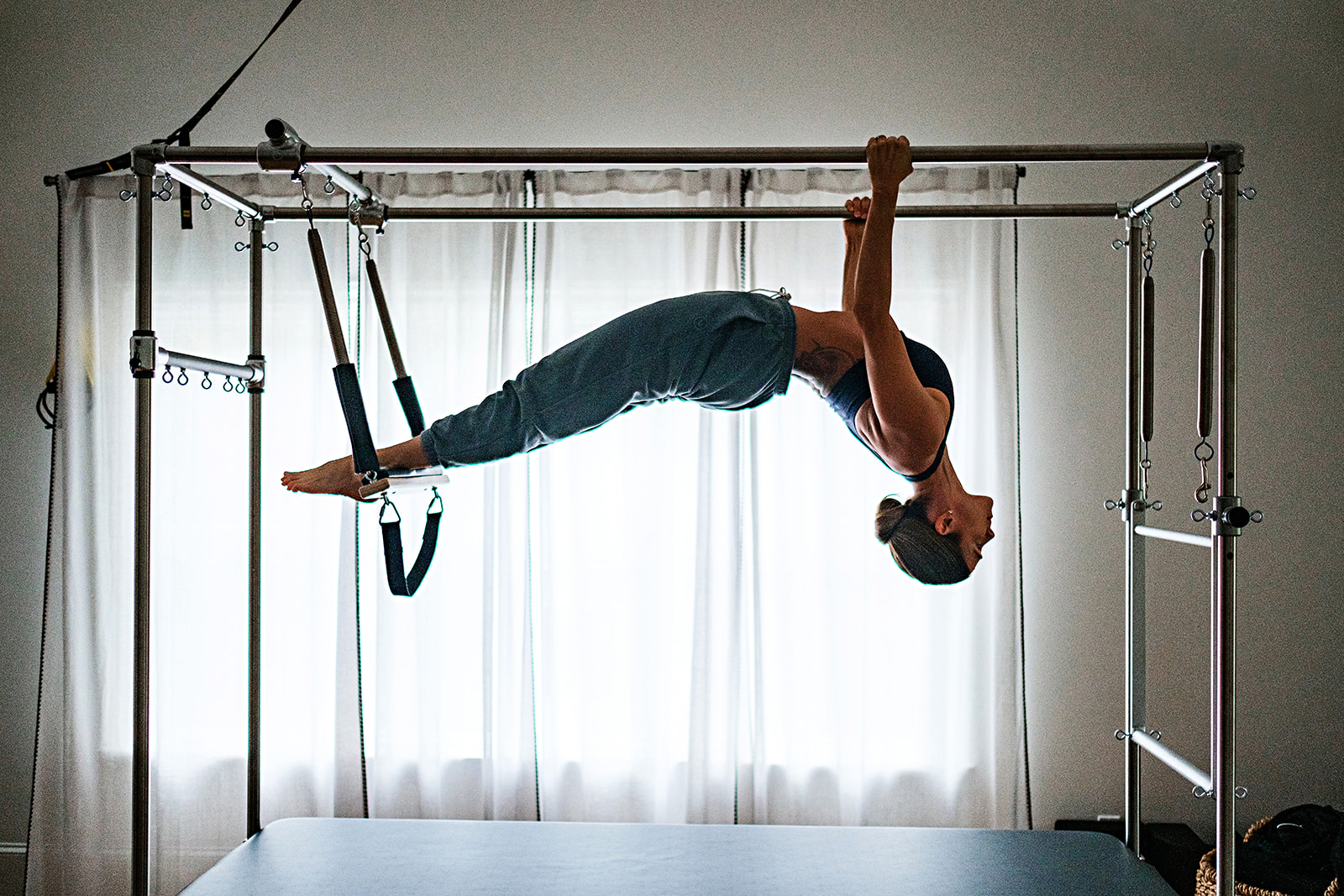


Classical, contemporary, Pilates-inspired—what do these labels actually tell you? Less than you might think. Here’s a better way to judge whether a Pilates class is worth your time.
“Real Pilates” is one of those phrases that sounds useful until you try to define it.
To some people, it means a strict classical sequence taught on traditional apparatus. To others, it means any thoughtful movement practice grounded in Pilates principles. Online, it may mean little more than coordinated activewear, ankle weights, and a series of pulses filmed in flattering light.
If you’ve bounced from one fitness trend to another, the confusion is irritating. You want to know whether the workout is legitimate—not because you care about winning an argument over lineage, but because you care about your body. Is the class well designed? Is the instructor paying attention? Are you learning something, or just surviving a random sequence that photographs well?
Those are the right questions.
The most useful definition of “real” Pilates is not a pedigree, a vocabulary test, or an aesthetic. It is intentional teaching. A good instructor should be able to explain why you are using this spring, doing the exercises in this order, and working toward this next challenge.
Before we get there, it helps to name the three broad camps.
Classical Pilates
Classical Pilates aims to preserve the method developed by Joseph Pilates as faithfully as possible. Teachers in this tradition generally use a recognizable repertoire, exercise order, transitions, and apparatus setup. Sessions often follow a clear system: the mat and machines are not separate collections of exercises but parts of one method.
At its best, classical Pilates has coherence. You are not choosing movements from a grab bag. Earlier exercises prepare you for later ones. Skills repeat across different pieces of equipment. The order itself teaches endurance, control, rhythm, and efficiency.
Classical teaching can also provide a valuable common language. If you study in one classical studio and visit another, much of the repertoire may feel familiar.
But “classical” is not automatically synonymous with excellent. Fidelity to an inherited sequence does not remove the need to observe the person in front of you. A teacher can know the order perfectly and still miss that a client is gripping, compensating, confused, or not ready for the next exercise. Tradition is a framework; it is not a substitute for judgment.
Contemporary Pilates
Contemporary Pilates keeps the method’s central ideas while allowing more adaptation. A contemporary teacher may incorporate current anatomy and movement research, modify the traditional order, use additional props, or select exercises for a particular sport, injury history, or goal.
That flexibility can be a strength. Bodies do not arrive in the studio with identical proportions, histories, or needs. A thoughtful modification can make an exercise more accessible, clarify its purpose, or create a better path toward the full version.
The risk is that “contemporary” can become so broad that the method loses its shape. If every exercise performed on a reformer counts as Pilates, the word stops telling you much. Good contemporary Pilates still has a through-line. The choices may differ from the classical order, but they should not be arbitrary.
“Pilates-Inspired” Workouts
“Pilates-inspired” is the loosest category. These workouts borrow elements associated with Pilates—controlled repetitions, core-focused cues, reformer-style equipment, small ranges of motion, or a certain visual language—without claiming to teach the full method.
That is not inherently bad. A Pilates-inspired class can be enjoyable, challenging, and well coached. The honest label may actually be useful: it tells you the class is a hybrid rather than a traditional Pilates session.
The problem begins when the aesthetic replaces the method. A reformer becomes a stage prop. Difficulty is created by adding instability, speed, or resistance without a clear reason. “Feel the burn” stands in for instruction. Everyone performs the same elaborate choreography whether or not they can control the underlying movement.
Novelty makes good content. It does not always make good programming.
The Reformer Does Not Make It Pilates
Pilates is not defined by lying on a sliding carriage. The reformer is a remarkably versatile apparatus, but equipment alone cannot give a workout logic.
Springs are not simply a difficulty dial, either. More resistance can make one phase of an exercise harder and another easier. A lighter spring may demand more control; a heavier one may offer useful support or feedback. The right choice depends on the exercise, the body, and the goal.
That is why “Why this spring?” is such a revealing question.
A thoughtful instructor might explain that the setting helps you organize the carriage, feel the connection through your legs, maintain control during the return, or prepare for a less-supported variation. The answer does not need to sound academic. It just needs to show that the choice was made on purpose.
The same is true of exercise order. Why are you doing footwork before a more demanding standing series? Why did the teacher repeat a similar pattern on the chair? Why are you practicing a simpler version today?
Good programming has an answer.
A Better Test for “Real” Pilates
Instead of asking whether a class is classical or contemporary, start with four more useful questions.
1. Can the instructor explain the choices?
There should be a reason for the spring setting, setup, sequence, and modification. “Because that’s how I learned it” may explain a tradition, but it does not explain how the choice serves the person doing the exercise.
2. Are they teaching the person or performing the class?
Watch for observation and response. Does the instructor notice how you move? Do they change the cue when the first one does not land? Do they offer a modification without making it feel like a demotion? Do they know when not to progress an exercise?
A polished demonstration is not the same as teaching.
3. Is there a progression?
A well-designed class is going somewhere. You may be building the control required for a harder exercise, connecting a pattern across several movements, or developing capacity over multiple sessions. You should not need to perform advanced choreography on day one to feel that the work is effective.
Progression also means that challenge is earned. Complexity should emerge from competence, not be used to disguise the absence of it.
4. Does form serve function?
Good form is not about making every body look identical. It is about organizing movement well enough to achieve the intended task without unnecessary strain. A useful cue helps you move with more control, clarity, or comfort. It should not force you into a picture your structure cannot—or need not—match.
What to Look for in a Class
Labels can still help you choose a starting point. If you value a defined system, repeated repertoire, and historical continuity, a classical studio may suit you. If you want more adaptation or goal-specific programming, a contemporary teacher may be a better fit. If you mainly want an energetic group workout with Pilates flavor, an honestly described Pilates-inspired class may be exactly what you want.
Whichever camp you choose, look for an instructor who:
- asks about relevant injuries, limitations, and goals;
- gives setup and safety instructions before adding speed or complexity;
- watches students rather than spending the entire class facing a mirror or camera;
- offers a reason for resistance and equipment choices;
- teaches foundations as skills, not punishments for beginners;
- provides meaningful options instead of assuming one version fits everyone;
- can tell you what you are building toward.
Be cautious when difficulty appears to be the only measure of quality. Shaking, sweating, and soreness can happen during effective exercise, but they do not prove that a session was well designed. Neither does a waitlist, a luxury studio, a famous training lineage, or an instructor’s follower count.
So, What Is Real Pilates?
Classical Pilates is real Pilates. Contemporary Pilates can be real Pilates. A hybrid class may contain thoughtful Pilates teaching, even if “Pilates-inspired” is the more accurate name for it.
The label is the beginning of the conversation, not the verdict.
Real Pilates has intention you can feel and reasoning your teacher can explain. The springs have a job. The order has a purpose. The exercises relate to one another. Your instructor is not merely delivering choreography; they are watching, deciding, and helping you build toward something.
You do not need a lineage debate to recognize good teaching. Ask the simplest questions: Why this? Why now? What comes next?
A good Pilates instructor will have an answer.


