

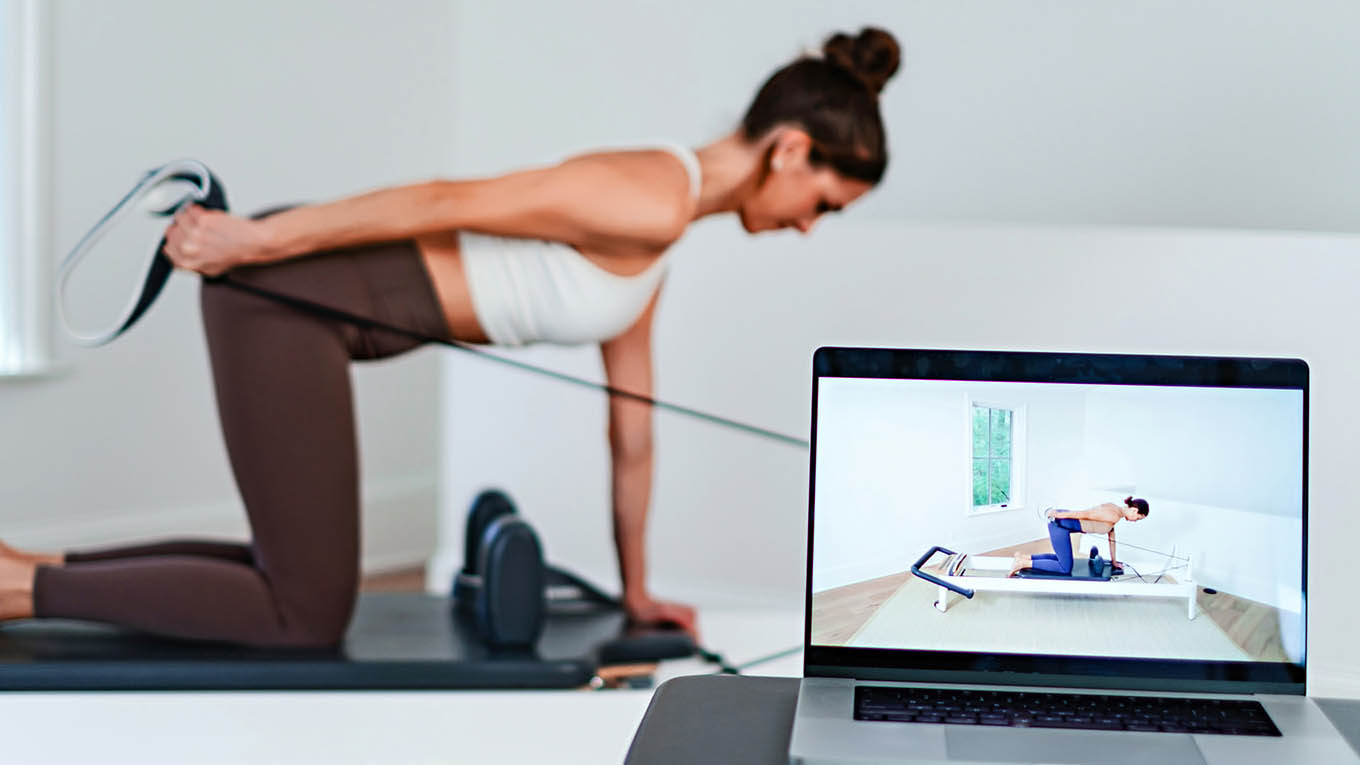


You love Pilates. You may even love your studio.
What you don’t love is paying close to $300 a month, rearranging your life around class times, driving across town, and discovering that the classes you actually want are all booked for weeks out.
Eventually, a question starts following you home:
Can I really get the same kind of results with a reformer at home?
My honest answer is yes—with one important condition.
A home reformer gives you access. It does not automatically give you consistency, progression, or good form. Those come from the way you use it.
If you replace your studio membership with random workouts whenever you happen to feel motivated, you may miss the structure of class. But if you create a realistic weekly schedule, follow thoughtful instruction, and progress gradually, home reformer Pilates can become an effective and sustainable practice.
Here’s what you should know before making the switch—and a four-week plan to help you do it without losing your momentum.
What Studio Pilates Gives You
There is a reason boutique Pilates studios have such loyal members. A good class offers more than access to a reformer.
A sense of community
Seeing familiar faces can make exercise feel social instead of transactional. Even if you don’t talk much during class, there is something motivating about moving alongside other people.
A studio also creates accountability. You reserved the class, put it on your calendar, and may lose the credit if you cancel. That little bit of pressure can help you show up on low-motivation days.
An instructor’s eyes on your form
A skilled instructor may notice that your shoulders are creeping upward, your pelvis is shifting, or you’re using momentum instead of control.
That feedback matters—especially when you’re new, returning after an injury, pregnant or postpartum, or learning a more advanced movement.
A clear beginning and end
Studio classes remove decision fatigue. You arrive, follow the instructor, and finish. You don’t have to choose the exercises or decide how long to work out.
Energy you don’t have to create yourself
Music, lighting, instructor cues, and the movement of the group can help you stay engaged. Some people genuinely perform better in that environment.
Those benefits are real. Switching to a home reformer does not require pretending otherwise.
What Studio Pilates Doesn’t Always Give You
A studio membership can be valuable without being the best long-term fit for your life.
Flexibility
A class at 9:00 a.m. only works if your morning cooperates. Traffic, childcare, meetings, and changing work hours can turn a 50-minute workout into a two-hour commitment.
At home, a 20-minute opening is enough time to move.
Reliable access
Paying for a membership does not always mean getting the classes you want. Peak-time sessions may fill quickly, and waitlists can make it difficult to build a dependable routine.
Your home reformer never runs out of spaces.
A consistent instructor
You may love one teacher’s cueing but struggle to get into their classes. Rotating instructors can also mean different terminology, pacing, and approaches from week to week.
At home, following a consistent instructor or a structured program can make your practice feel more cohesive. You become familiar with the cues, understand what is expected, and can recognize your progress over time.
Better value for frequent practice
If you want to practice three, four, or five times a week, studio costs can rise quickly. At home, your cost is not tied to the number of sessions you complete.
The more consistently you use your reformer, the more useful that investment becomes.
Can You Really Get Results From Reformer Pilates at Home?
Yes—but your results will come from a consistent, appropriately challenging practice.
At-home reformer Pilates can help you develop strength, control, mobility, balance, and body awareness. As with studio Pilates, progress depends on several factors:
- How regularly you practice
- Whether the workouts match your current ability
- Whether you use controlled, intentional movement
- How your resistance and exercise complexity progress
- Whether you modify movements when something feels wrong
Your first signs of progress may include better control, improved posture awareness, smoother transitions, or more stability.
The main limitation at home is immediate feedback. A video instructor cannot see your individual alignment. That does not make home practice ineffective, but it does mean you need to work deliberately.
Start with movements you already recognize. Choose clear, instructor-led programming. Use a mirror or record a short section of your workout occasionally. If you experience pain, have an injury, or are unsure whether a movement is appropriate for you, consult a qualified instructor or healthcare professional.
Home Pilates works best when confidence grows alongside challenge.
Before Week One: Set Up Your Home Practice
Your transition begins before your first workout.
Choose a permanent or easy-to-access place for your reformer. If every session requires moving furniture, finding accessories, and rebuilding your space, the friction will eventually win.
Then decide when you will practice.
Don’t tell yourself, “I’ll do Pilates whenever I have time.” Choose actual days and general time windows. Treat them like studio reservations—even though you now have the freedom to move them when life changes.
A simple starting schedule might be:
- Monday: 30-minute full-body session
- Wednesday: 20-minute lower-body, upper-body, core, or mobility session
- Saturday: 30-minute full-body session
You can always do more later. First, prove that your routine fits your life.
Your 4-Week Studio-to-Home Transition Plan
Week 1: Learn Your Reformer
Goal: Build familiarity and remove uncertainty.
Your home reformer may feel different from the studio equipment you know. The carriage, springs, straps, footbar, and range of motion can vary between machines.
This is not the week to chase the hardest workout you can find.
Complete two or three beginner sessions of approximately 20 to 30 minutes. Focus on setup, safe transitions, spring changes, and exercises you already recognize.
Good choices may include familiar footwork, bridging, arm work, feet in straps, and basic core exercises—as long as they are included in your guided program and appropriate for your experience.
Your Week 1 checklist:
- Learn how to adjust the reformer correctly
- Check that the machine is stable before each session
- Practice controlled carriage movement
- Make spring changes without rushing
- Complete at least two scheduled workouts
- Note any cue or exercise that feels unclear
You may finish a session feeling like you could have done more. That is fine. The goal is to make your second workout feel easier to begin than your first.
Week 2: Rebuild the Studio Routine at Home
Goal: Create consistency.
Now it is time to make your home practice feel like a real appointment.
Choose three sessions for the week and put them on your calendar. Prepare your water, towel, and accessories before you begin. Silence notifications. If possible, follow the same instructor or program throughout the week.
Try this schedule:
- Session 1: 30-minute full-body session
- Session 2: 20-minute lower-body, upper-body, core, or mobility session
- Session 3: 30-minute full-body session
Pay attention to the quality of your repetitions. Pilates is not about moving the carriage as far or as fast as possible. Use the tempo and range you can control.
At the end of each workout, record one quick note:
- What felt stronger?
- What felt confusing?
- Where did you lose control?
- What would you like to repeat?
This replaces some of the feedback loop you had at the studio.
Week 3: Add Progressive Challenge
Goal: Move beyond simply completing workouts.
By Week 3, the setup should feel more natural. Now you can begin progressing thoughtfully.
Progress does not always mean adding more resistance. Depending on the movement, a lighter spring may require more stability and control. Challenge can also come from slower tempo, cleaner transitions, longer sets, greater precision, or a slightly more advanced variation.
Complete three or four sessions:
- Two full-body sessions
- One lower-body, upper-body, or core session
- One shorter session focused on stretching, or working out lying down
Choose one or two ways to progress—not all of them at once.
For example:
- Add a 5 to 15 minute session after your originally planned workout
- Try one new variation taught in your program
- Focus on your breath and the rhythm of an exercise
- Improve your range without losing alignment
- Repeat a previous class and notice what has changed
Avoid improvising advanced exercises simply because they look impressive online. Your home practice should become more challenging because your control is improving, not because the movements are becoming riskier.
Week 4: Build Your Long-Term Weekly Schedule
Goal: Create a routine you can sustain after the excitement of the first month.
Review the previous three weeks. Which session length did you complete most consistently? What time of day worked? Which instructor made you feel clear and confident? Did three longer workouts fit your life, or would four shorter sessions be easier to maintain?
Use those answers to create your ongoing schedule.
A balanced example:
- Monday: 30-minute full-body
- Wednesday: 10 to 20-minute core-focused
- Friday: 10 to 20-minute feel-good workout
- Saturday: 30-45 minute full-body
If you enjoy studio energy or need occasional form feedback, your choice does not have to be all-or-nothing. You might keep one studio class or private session each month while completing most of your workouts at home.
That hybrid approach can give you periodic instructor feedback without requiring a full studio membership.
How to Stay Consistent When No One Is Waiting for You
The hardest part of home Pilates is rarely the workout. It is starting the workout.
Make starting as easy as possible:
- Keep your reformer ready to use
- Schedule workouts at the beginning of the week
- Choose the class before your session starts
- Use shorter workouts on busy days instead of skipping
- Track completed sessions
- Repeat classes so you can see measurable progress
- Follow a structured series rather than choosing randomly every day
And remember: a 10-minute session you complete is more useful than a 50-minute session you keep postponing.
The Honest Bottom Line
A studio gives you community, live feedback, and built-in accountability. Those things have real value.
A home reformer gives you something studios often cannot: the ability to practice when your energy, schedule, and life allow it.
You no longer have to plan your day around traffic, wait for a spot to open, or abandon your workout because the only convenient class is full. You can do 20 minutes before work, a longer session on the weekend, or a gentle mobility class when that is what your body needs.
Can you get results at home?
Yes—if you replace the structure of the studio with a structure of your own.
You don’t need to be perfect. You need a realistic schedule, quality instruction, and a program you will return to week after week.
Ready to Try Reformer Pilates on Your Schedule?
Start your free trial and follow guided reformer workouts designed to take the guesswork out of practicing at home.
Choose your class. Press play. Build a routine that finally fits your life.


