

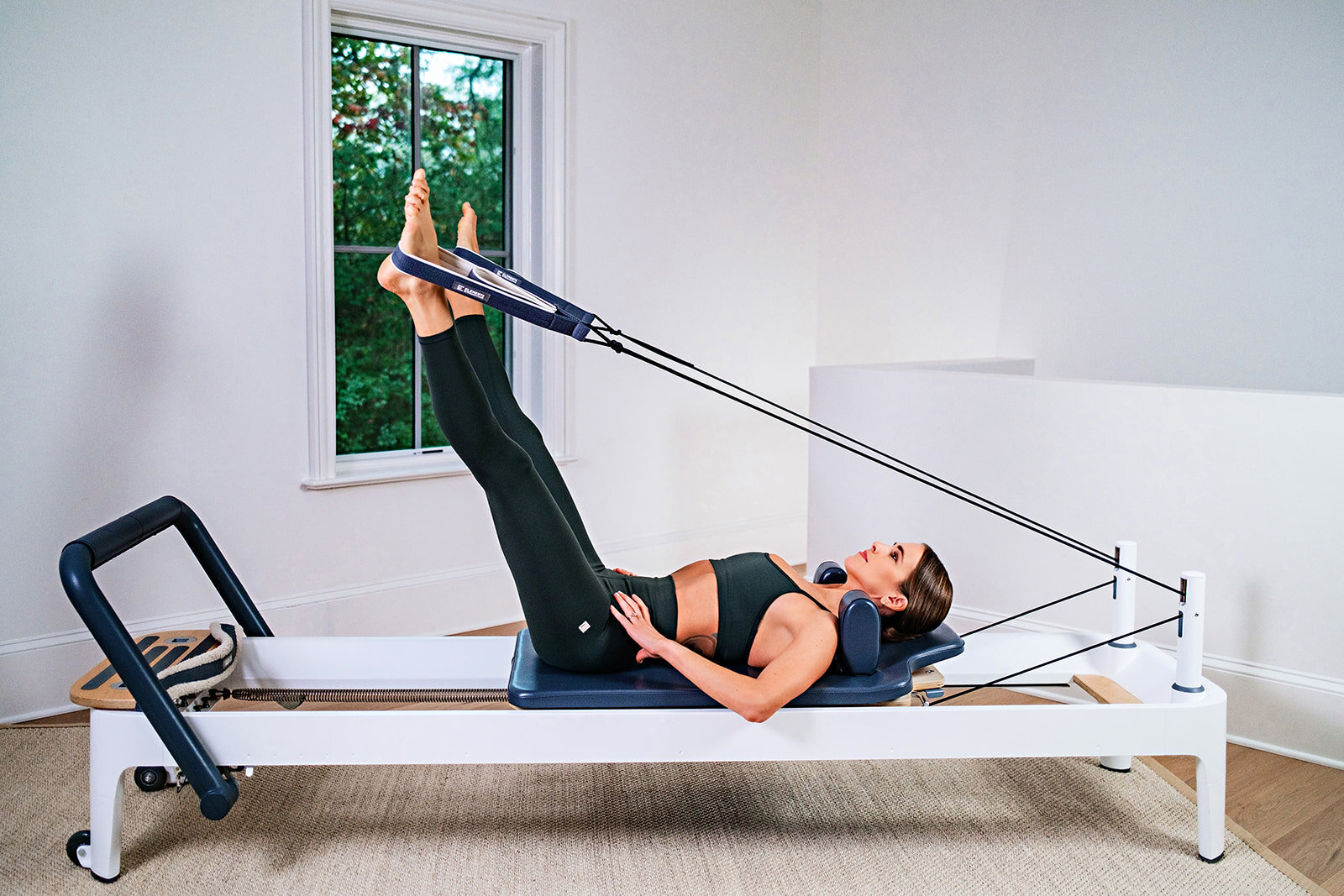


Feet in straps is a lying reformer exercise where both feet sit in the long straps and the legs move while the pelvis stays still. A full sequence covers leg sweeps, frog, openings and circles. It’s a pelvic stability exercise, which means the work is in the core as much as the legs.
How to set up the reformer for feet in straps
Springs: two heavy. On a Balanced Body reformer that’s two reds. Spring colours are not standard across manufacturers, so go by resistance.
Footbar in the high position. Headrest up if you prefer it up.
Lie on your back with your feet on the bar. Take your straps, then push away from the bar with your feet.
Place one foot in a strap, making sure the strap sits close to your heel. Reach that leg up to the sky but keep the knee bent, holding tension on the strap. Then bring the second foot in.
Finding your starting position: legs together, bring them up as high as you can while keeping the tailbone down.
If you pull the legs further than your flexibility allows, the pelvis tucks and the lower back squashes into the carriage. Push a little further away and slide the pubic bone away from you. That’s neutral pelvis. Keep the rib cage down.
How to do feet in straps, step by step
1. Leg sweeps
Stretch the legs up and squeeze them together, knees unlocked. Sweep them down to about 45 degrees, or as far as you can while keeping the abs hugged in and the back ribs anchored. Sweep back up.
The hips stay stable throughout — the pelvis shouldn’t rock back and forth or side to side. You’re moving between the two points you found when you set up.
Keep the knees unlocked so you aren’t pulling on the knee joints. You want the hamstrings drawing the legs down.
Reaching further into the straps helps engage the core.
2. Frog
Lower the legs to 45 degrees and externally rotate: heels together, toes apart.
Bend the knees, but only as far as you can go while keeping the pelvis untucked. Then push back out. Drag the heels in, press away. Flex the feet to pull the heels in, point as you press out.
As you press out, feel the pelvic floor zipping up at the front and the back, and the inner thighs spiralling towards each other.
The cue that changes it: as you drag the heels in, imagine dragging them through thick mud — resist, squeeze the heels tight. As you push the legs out, imagine pushing a very large elephant through a very small window.
Keep the heels on the midline of the body as they come in and out.
3. Openings
Hold the legs out, staying externally rotated. Press down into the back rib cage a little more.
Open the legs as wide as feels good, then pause. Keep reaching into the straps as you slowly bring the heels back together until they meet.
4. Circles
Still externally rotated, scoop the legs up. Open them out to the sides, circle around and down, together, and back up. Hold the external rotation throughout.
Then reverse: down, open, around, up.
There are variations — legs turned in, legs parallel, or a combination. Being specific about which one you’re doing is a skill worth having, because you’re working muscles the body doesn’t reach for naturally.
5. Butterfly stretch to finish
Bottoms of the feet together, knees open out to the sides.
6. Coming out
Take your feet out of the straps one at a time and place them back on the bar.
Three mistakes to avoid in feet in straps
Bringing the legs up past your flexibility. The pelvis tucks and the lower back presses into the carriage. Push further away and slide the pubic bone away from you until you’re back in neutral.
Locking the knees. That pulls on the knee joints instead of letting the hamstrings draw the legs down. Keep them unlocked.
Letting the pelvis rock. Front to back or side to side. If it’s moving, the legs have gone further than the core can hold.
Modifying feet in straps for shoulder, knee or pelvic floor concerns
Range is the adjustment here. A smaller sweep with a still pelvis does more than a large one with a rocking pelvis.
Not sure where to start?
You’ve got feet in straps. Where does it fit in a week? Answer a few questions and we’ll point you to the right level.
Related Exercises
- Feet in Straps on the Reformer: How to Set Up and Do It
- Reformer Core Exercises: A 15-Minute Abs Workout
- How to Use a Pilates Reformer Machine: A Beginner’s Guide
- Reformer Pilates Video: A 7-Minute Full-Body Class
- Scooter on the Reformer: How to Set Up and Do It
Common questions about feet in straps
Two heavy springs. On a Balanced Body reformer that’s two reds. Or one heavy and one medium for less resistance.
So the movement can initiate from the hamstrings rather than pull on the knee joints.
The legs have come up further than your flexibility allows, which tucks the pelvis. Press the legs further away and slide the pubic bone away from you to find neutral again.
Both, but the core is doing more than it looks. It’s a pelvic stability exercise, and pelvic stability means core work.


