

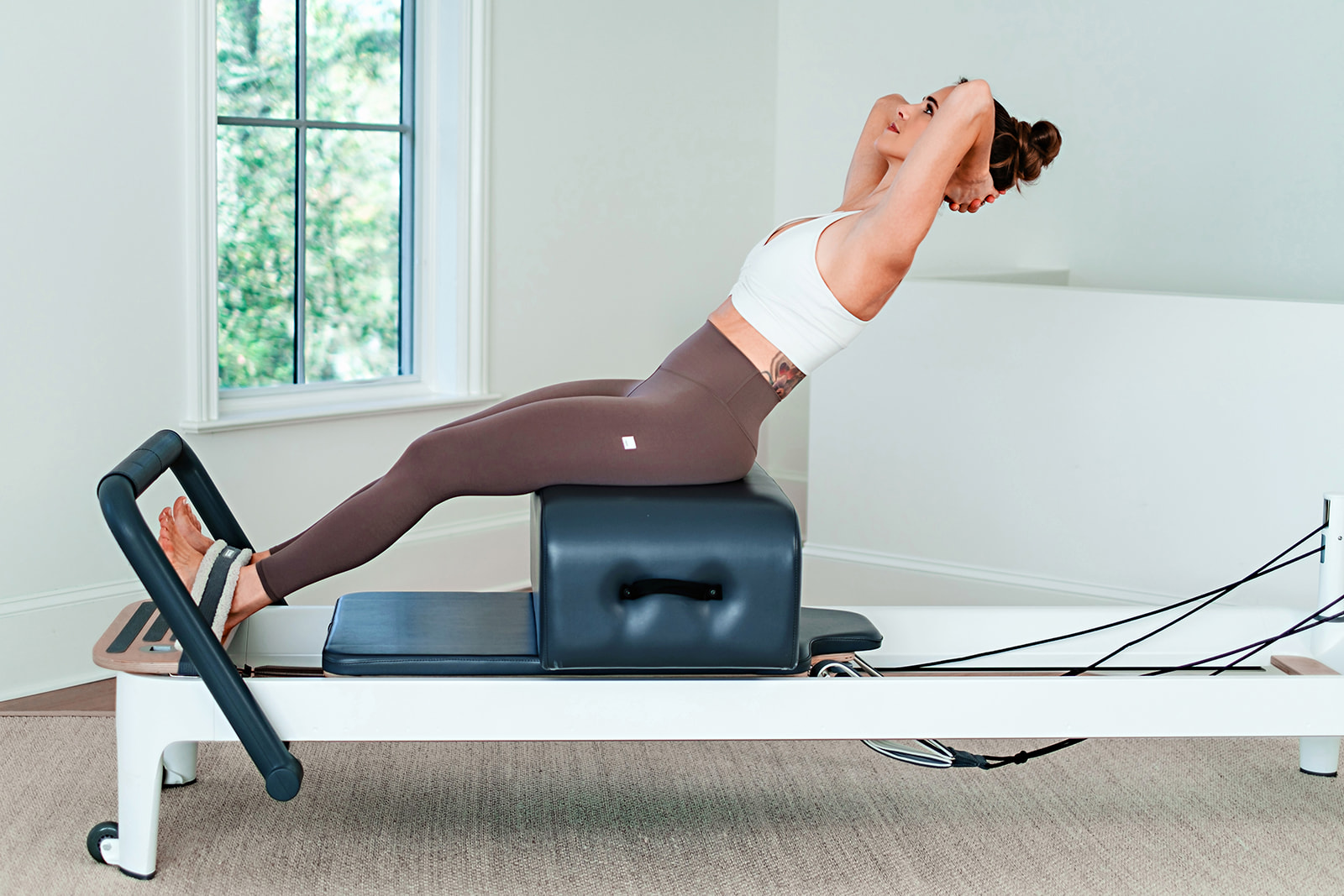


Reformer core exercises use the carriage and springs to load the abdominals. This fifteen-minute workout moves through arms in straps, curl-and-press, standing pulls, seated roll-backs and plank, changing springs throughout. No props needed.
Fifteen minutes, no props. All you need is a reformer.
How to set up for the workout
You’ll use three springs across the workout, one at a time: one red (heavy) to start, one blue (medium) for most of it, and one yellow (the lightest on a Balanced Body machine) for the standing work.
Spring colors are not standard across manufacturers. If yours don’t match, go by resistance: heavy, medium, lightest.
Footbar up high for the opening sequence. Headrest up or down, whichever you prefer.
Find neutral before you start. Lying on your back, tuck and untuck the pelvis a few times, then make the movement smaller until you find the spot in between. Ribs down. That’s the position you hold through the first sequence.
Set the shoulders. Arms reach to the ceiling with dynamic range, and slide the shoulder blades down your back.
How to do the workout, move by move
1. Arms in straps with tabletop legs — one red
Hands in the short loops, arms to the ceiling. Once the shoulders are set, bring one leg to tabletop, then the other.
Arms pull slowly down to the carriage and back up. Keep reaching into the straps. The navel draws up for the pelvic floor and in for the transverse abdominis. As the arms go down, don’t let the back of the shoulders rise.
Progression: as the arms press down, extend one leg out towards where the ceiling meets the wall. Not too low — go higher if you lose the core connection or the ribs come off the carriage.
Then add the curl: nod the chin, curl up, and let the leg reach a little lower. Bend the knee, arms up, head down. Alternate sides. Keep reaching into the straps as the pelvic floor lifts in the opposite direction.
2. Curl and press with rotation — one blue
Toes on the bar, hip distance apart. The carriage doesn’t need to come all the way in — press out until the knees sit over the hips.
Nod the chin, lift head and shoulders, hands behind the head, staying at the bottom tips of the shoulder blades. Check the pelvis hasn’t tucked, unless you’re modifying for lower back issues. Navel up and in.
Exhale press the bar away, inhale bend the knees back in. Feel the legs pushing out as the navel draws up and in, away from the legs.
Single leg: bring the carriage in and send one leg over the bar, bending it as you press out. Hold. Keep pressing into the bar with the standing foot.
Rotation: foot back down, rotate the ribs to the right — think bottom left rib to right hip bone. Bend the knees in, exhale press out. Try not to let the sacrum rock back and forth. Anchor down into the opposite hip. Repeat everything on the second side.
3. Standing single-leg pull — one yellow
Step off and walk round to the well behind the machine. Legs together, carriage in to start. Hook one heel on the outside of the shoulder block. The standing ankle sits directly under the hip — not leaning forwards or back. Hands on hips.
Standing knee unlocked. Push into the floor and grow tall: tail pulling down, lower abdominals pulling up, crown of the head reaching up.
Inhale to prepare and find your stability. Exhale, pull the heel forwards towards you. Inhale, slowly return.
Then hands behind the head, same movement. Press into the standing foot as the working heel draws towards you, deepening the scoop. Grow tall as the heel pulls in.
Then add rotation towards the working leg. Exhale rotate, inhale return.
Switch sides. One side will feel harder than the other — everyone has one.
4. Seated roll-back, hug a tree — one blue
Sit on the carriage, legs straight between the shoulder blocks, a little space behind you. Straps off the shoulder blocks, hold the short loops, arms out in front with the knuckles together as though hugging a tree. Shoulder blades wrapped into their pockets.
Inhale grow tall. Exhale, tuck the tail and start to roll back, pulling the knuckles closer to the chest. The further back you go, the more the tailbone tucks under and the more the pelvis tilts — you’re pushing the carriage forwards with your tailbone. Reach the toes forwards. Roll all the way back up and grow tall.
Then hold the roll-back: squeeze the inner thighs, open the arms out to the sides keeping the carriage steady, small bend in the elbows, big scoop of the belly. Press back, then bring the arms to the front. Toes reaching away from the belly, belly reaching away from the toes.
5. Bicep curl, flat back then C-curve — one blue
Legs on the outsides of the shoulder blocks, squeezing them gently. Hands still in the short straps.
Flat back first: sit as tall as you can, toes pointed. Bend the elbows and extend. Scoop as you bend, release the core as you extend.
Then in the C-curve: elbows stay high, roll back, drop the shoulders, draw the abs in, gentle squeeze of the shoulder blocks with the legs. Bicep curl, scooping as you go. Then flex the feet on the curl and point on the extend.
Watch for the chest gradually closing off. Pull the shoulders back, collarbones wide, and visualise the lower abdominals lifting.
6. Plank, hands then forearms — one blue
Hands on the carriage about halfway up, fingertips off the edge. Shoulders over wrists, slight tuck to the tail, shoulders pulled back, belly in. Press the carriage out into plank and hold.
Bend the knees in a little, then press back out — stopping just before the knees hit the carriage. Scoop the belly as you press out.
Then forearms: knees down, come onto the forearms with the hands clasped between the shoulder blocks, shoulders pulling back. Press out into plank, tail pulling towards the heels, navel in. Bend the knees towards the well and press back out. Keep pulling the breastbone through.
Finish by bringing the carriage in and placing the knees on it.
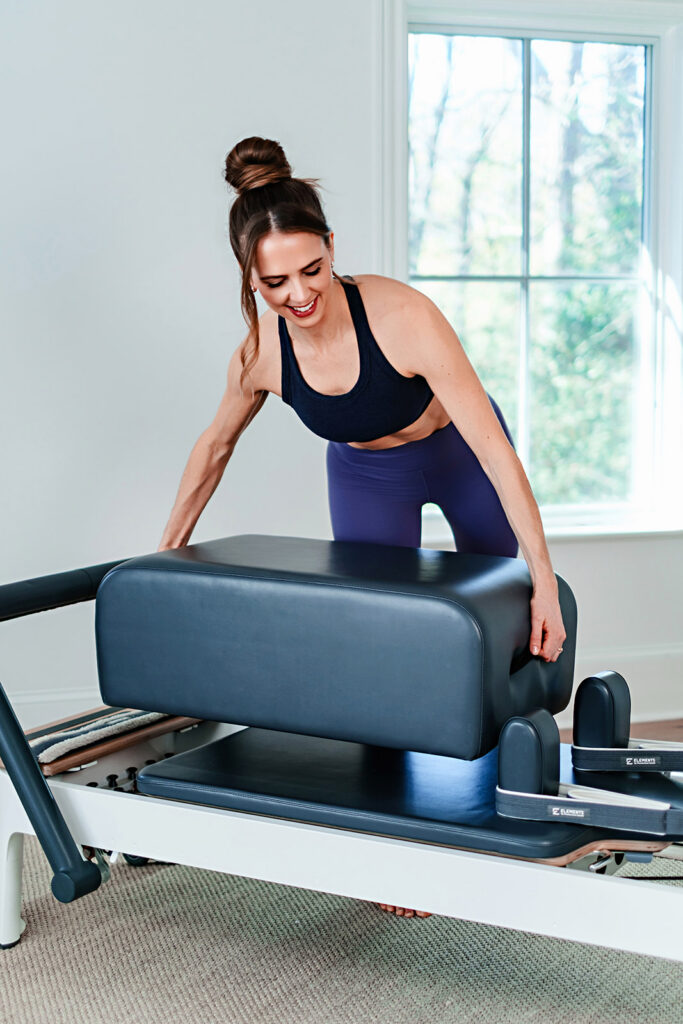
Not sure where to start?
Knowing the moves is one thing. Knowing which ones, in what order, is another. Answer a few questions and we’ll point you to the right level.
Related Exercises
- Feet in Straps on the Reformer: How to Set Up and Do It
- Reformer Core Exercises: A 15-Minute Abs Workout
- How to Use a Pilates Reformer Machine: A Beginner’s Guide
- Reformer Pilates Video: A 7-Minute Full-Body Class
- Scooter on the Reformer: How to Set Up and Do It
Common questions about reformer core classes
Three, used one at a time: one heavy for the opening sequence, one medium for most of the workout, and the lightest on your machine for the standing work.
No. This workout uses the reformer and nothing else.
Yes. There are many beginner-friendly core exercises.
Everyone has a harder side. It shows up most in the standing work, where stability rather than strength is doing the job.
Depending on the lower back issue, we may modify in different ways. You can avoid spinal flexion by placing a small rolled up towel under the lower back to stay in neutral spine, and do a flat back hinge instead of a c-curve spine.


