

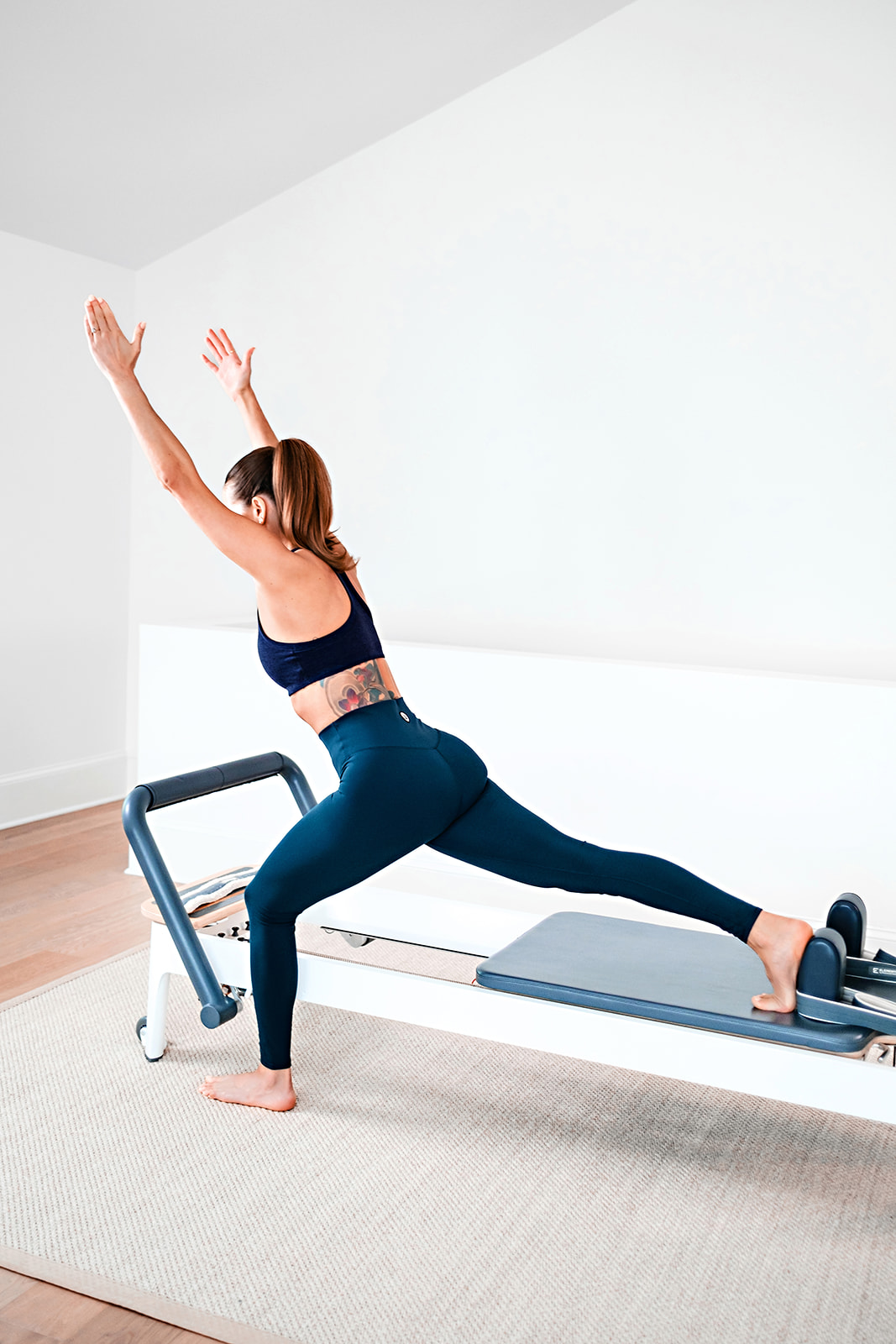


The scooter is a standing glute exercise on the reformer. One foot rests against the shoulder block, the other stays planted on the floor, and you press the carriage away by extending through the heel. It builds glute and hamstring strength and hip stability.
How to set up the reformer for the Flat Back Scooter
Springs: one red/heavy and one yellow/light. For another challenging version, take the yellow off and work on one red alone without holding the bar.
Stand at the side of the machine. Your inside foot goes against the shoulder block, inside hand on the footbar. Walk the outside foot back along the floor until the knees line up. The free hand goes behind your back.
Once your foot is on the carriage, notice that the hips level themselves. They stay level for the whole exercise.
Find neutral spine — the natural curve. Not rounded in the back, not overarching. Abs drawn in.
Spring colors are not standard across manufacturers. If yours don’t match, go by resistance: one medium-heavy and one light.
How to do the scooter, step by step
1. Set the position
Inside foot against the shoulder block, inside hand on the footbar, outside foot walked back, free hand behind your back. Hips level, spine neutral, abs in.
2. Press out
Engage the glute of the leg on the carriage and push the carriage all the way out. Then bring it back in with control.
3. Lead with the heel
If your heel sits over the shoulder block rather than against it, push the heel as though you’re trying to reach the wall behind you. The heel goes first, before anything else.
4. Press all the way
Don’t stop the carriage halfway. Full extension is where the glute work is. Think of reaching your hamstring, or back of thigh bone to the sky.
5. Pick up the pace
Once the position is solid, speed it up — out, in, out, in — still leading through the heel, keeping the stability in the hips.
6. The balance challenge version
Take off the yellow spring and work on one red, with both hands behind your back. Less spring and no hand on the bar means more balance work.
Three mistakes to avoid in the scooter
Not pressing all the way out. The most common one. Stopping short takes a lot of the glute out of it.
Letting the standing hip drift out to the side. The hip on the standing side wants to push outwards. Don’t let it — keep both hips pointing straight ahead the whole time.
Forgetting the heel. If the leg extends without the heel leading, you lose the connection into the glute.
Modifying the scooter for shoulder, knee or pelvic floor concerns
The load is changed by your foot position, or you can lighten the spring tension.
Too heavy? Walk the outside foot forwards. That reduces the resistance.
Want more? Walk it back.
Not sure where to start?
You’ve got the scooter. Where does it fit in a week? Answer a few questions and we’ll point you to the right level.
Related Exercises
- Feet in Straps on the Reformer: How to Set Up and Do It
- Reformer Core Exercises: A 15-Minute Abs Workout
- How to Use a Pilates Reformer Machine: A Beginner’s Guide
- Reformer Pilates Video: A 7-Minute Full-Body Class
- Scooter on the Reformer: How to Set Up and Do It
Common questions about reformer core classes
It’s a glute and hamstring exercise. Hip stability and balance come along with it, as well as core strength to stabilize it all.
One red and one yellow to start. To progress, try one heavy/red and one medium/blue. One red alone for the balance challenge version.
Usually one of two things: you’re not pressing all the way out, or the heel isn’t leading the movement.
Move your standing foot. Forwards for less resistance, back for more.
Yes — the beginner class includes a round-back variation before the neutral-spine version.


