


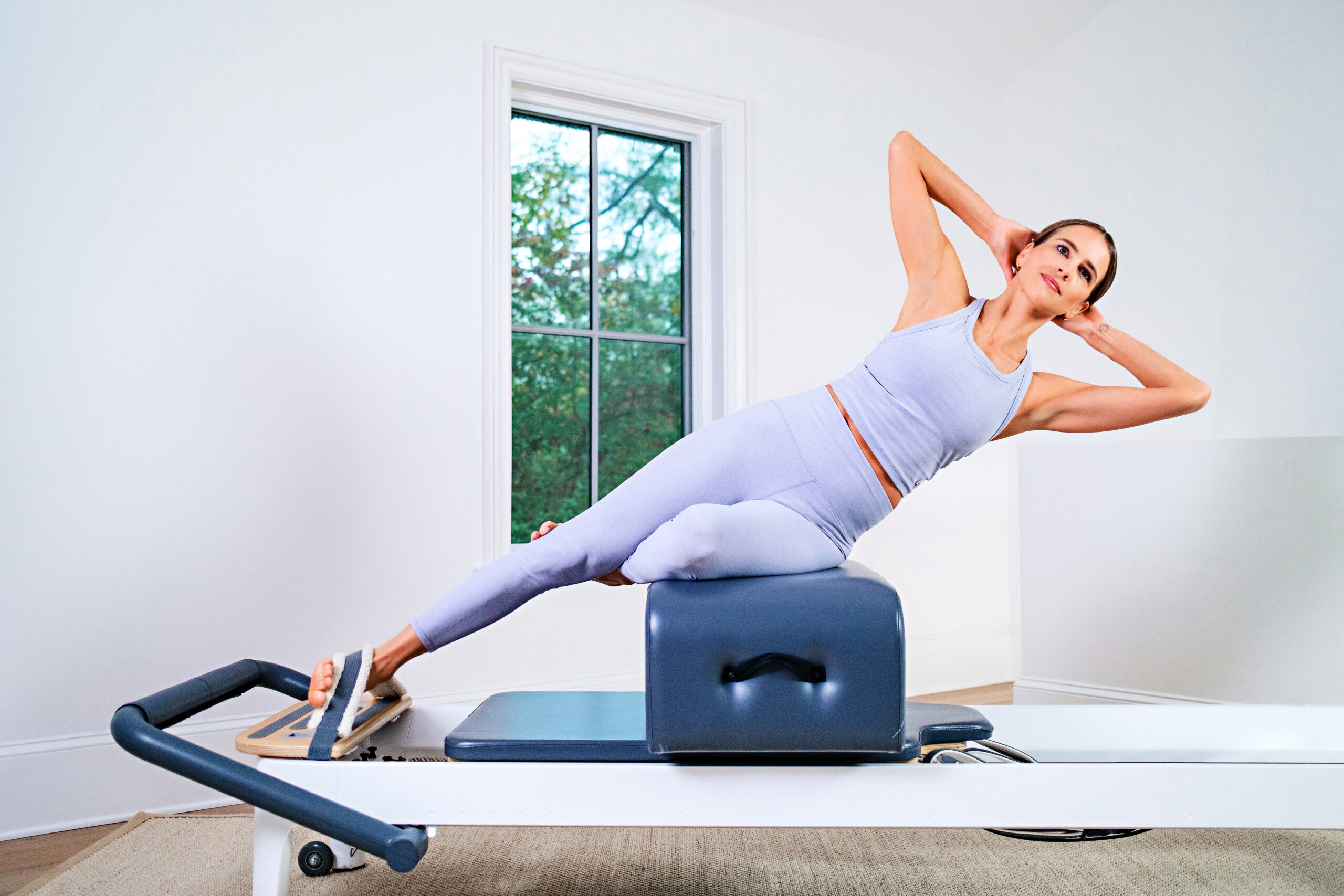
A Pilates reformer is a sliding carriage on rails, with springs for resistance, a footbar, shoulder blocks and hand and feet straps. You control the load by changing which springs are attached. A beginner session works through pelvic curls, hands in straps, feet in straps and kneeling work, adjusting springs between exercises.
Follow along with the full class, or read through first if it’s your first time on the machine.
How to set up a Pilates reformer
Footbar position varies by machine. Set it so that when you’re lying down with your feet on the bar and knees bent with the carriage fully in, your knees are at a comfortable degree of flexion. If they’re over your hips, the bar needs to be pushed back (away from you). If your knees are bent less than 90 degrees, move the footbar closer.
Headrest down for anything lying on your back when your hips lift up higher than your chest.
Straps: Always make sure they’re not tangled up.
Springs: The more springs you attach, the greater the resistance when you push the carriage away. Some exercises are more difficult with heavier resistance, while others—such as Bridges—become more challenging with lighter resistance.
Spring colours are not standard across manufacturers. If yours don’t match the video, go by feel and change one spring at a time.
How to do Reformer Pilates: 10 moves, step by step
1. Seated pelvic tilt — no springs
Sit on the edge of the carriage, right on top of your sit bones, legs together, feet in the well. Core engaged, crown of the head lengthening to the ceiling. Tuck the tailbone, then untuck. Tuck, roll back slightly, restack the spine.
2. Bridge — one medium, two heavy springs
Headrest down, heels on the footbar, neutral spine. Tuck the tailbone, press the lower back into the carriage, roll up one bone at a time to the tips of the shoulder blades. Inhale at the top, exhale to roll down.
4. Bridge on a lighter spring — one medium, one heavy
Same movement, less spring, harder to keep the carriage in.
5. Hands in straps — long straps
Arms to the ceiling, neutral spine, legs in table top. Arms press down to the carriage and back up. The movement comes from the back, not the hands.
6. Ab curl with straps
Nod the chin to lengthen the back of the neck, then curl head and shoulders up as the arms press down. Ribs stay down. To progress, extend the legs to the ceiling and lower them, as long as the ribs stay heavy and the belly stays scooped.
7. Feet in straps — Lowers, Frog, Circles
Neutral spine throughout. Legs squeezed together, knees soft, lower to 45 degrees and back up without the ribs or tailbone lifting. Then heels together, toes apart, knees over hips, and zip the inner thighs — imagine holding a coin between the heels. Then circles, only as wide as you can keep the pelvis still.
8. Short Spine Stretch
Only for people who can do deep spinal flexion and inversions. This exercise is challenging and may take a few sessions to understand. Let the straps draw your feet over your face. Carriage clicks in. Lift to the shoulders, keep tension on the straps, heels together and toes apart. Bend the knees to the shoulders, then roll down one bone at a time, thighs hugging the chest.
9. Scooter — one heavy, one light spring
Standing, one foot against the shoulder block, the other stepped back on the floor to the side of the machine so that knee is aligned with the other. Hand on the footbar. Round-back version first: tuck the tailbone, look down, hips square to the front. The leg won’t fully extend, because the pelvis stays tucked. Then the flat-back version: chest open, neutral spine, press all the way out.
10. Kneeling Abs, then Elephant
Knees down, feet against the shoulder blocks, hands on the footbar. Press out until you’re a straight line from knees to shoulders, hold that kneeling plank, then push the carriage away with your arms and draw back in. Finish with the elephant: hands on the bar, weight into the legs, tailbone lifting, dragging the carriage in on the exhale.
Not sure where to start?
Knowing the moves is one thing. Knowing which ones, in what order, is another. Answer a few questions and we’ll point you to the right level.
Related Exercises
- Feet in Straps on the Reformer: How to Set Up and Do It
- Reformer Core Exercises: A 15-Minute Abs Workout
- How to Use a Pilates Reformer Machine: A Beginner’s Guide
- Reformer Pilates Video: A 7-Minute Full-Body Class
- Scooter on the Reformer: How to Set Up and Do It
Common questions about using a reformer
Yes. Work through a sequence of exercises, suited for your level, that are clearly explained rather than picking exercises at random.
They indicate resistance, but the colours are not standard across manufacturers. Check your machine’s guide, or go by feel.
No. A first session can be done without one.
Around fifteen minutes is enough to work through the sequence above without rushing the setup between exercises.
Learn more on our other blog How Often Should You Do Pilates? A Smart Guide for Real Progress.


